Tokyo's matcha moved into the coffee shops
Trend · 5 min read
Not one of the matcha specialists we have reviewed in Tokyo is a tea house. They are coffee bars, a converted bathhouse, a guitar brand's cafe, and now a shisha bar.
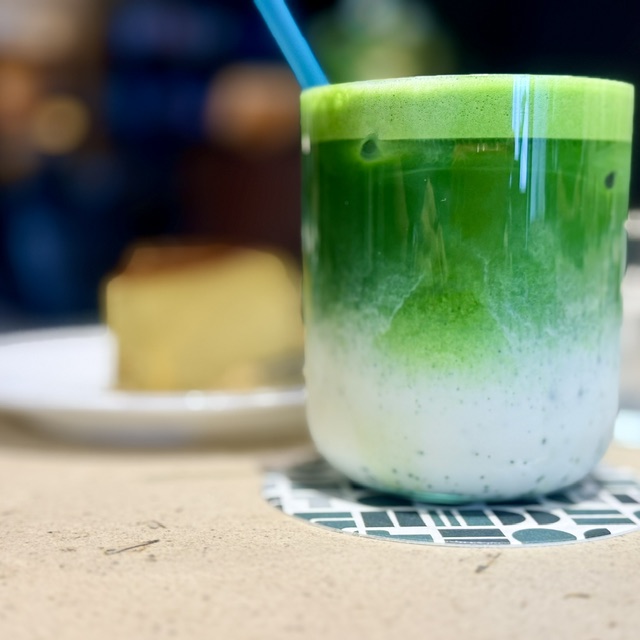
If you came to Tokyo looking for serious matcha, the obvious move is to find a tea house. Sit on tatami. Watch someone whisk it properly. Pay for the ceremony as much as the bowl.
That is not where the interesting matcha is anymore.
We have reviewed eleven places in Tokyo running a genuine matcha program rather than a sweetened afterthought. Ten of them are coffee shops. The eleventh is a bar that also sells shisha. Not one is a tea house, and that is not because we avoided them. This site reviews tea houses. There are several in the Tokyo catalog. None of them turned out to be where the matcha conversation is happening.
Origin, named the way coffee names it
The clearest signal is on the menus.
At Hatoya in Kamiyamacho, the matcha is a No. 1 Blended Gogumi from Ujitawara in Kyoto. At THREE in Sangenjaya it is a stone milled Yame No. 1 from Fukuoka. At note, and again at LATTE ART MANIA, it is Kyoto Uji, named as such.
Ten years ago a Tokyo cafe menu said matcha latte and stopped there. Now it tells you the growing region, the cultivar blend, and how it was ground. That is exactly the vocabulary specialty coffee spent two decades teaching people, applied to a different leaf. The people writing these menus learned it from the coffee side, because they came from the coffee side.
The menus stopped saying matcha and started saying where it came from. That is a borrowed habit, and you can see whose.
MATCHA PASSPORT, up a flight of stairs in Shimokitazawa, takes it furthest. Staff walk you through single-origin varieties by name before you order, the Tanuki from Wazuka in Kyoto among them, the way a roaster walks you through beans rather than just pulling a shot. Bags of it go home with you afterward. It does not sell coffee at all, and it still is not a tea house. It is the one place in this set built around matcha alone, and it borrowed the coffee industry's whole model to do it, not the tea ceremony's.
When the matcha outranks the espresso
Here is the part we did not set out to find.
Writing these reviews at different times, months apart, we independently described two different cafes the same way: the matcha was good enough to make the espresso menu feel like a backup plan. Once is a phrase. Twice, unprompted, is a pattern.
It keeps showing up. At MATCHA&ESPRESSO MIYANO-YU the espresso is genuinely good and still not the reason to go. At Byron Bay in Kojimachi, an Australian family roastery that has been roasting since 1989, the espresso is exactly as competent as that history suggests and the matcha latte is the order that surprises people.
These are not places that gave up on coffee. They are places where the matcha is quietly winning on its own menu.
The rooms are the giveaway
Look at where this is actually happening.
MIYANO-YU is a converted public bathhouse in a Nezu backstreet. LAMBERT is a seventy year old house in Shinjuku, reservation only if you want to sit inside. FENDER CAFE is the guitar company's first standalone Tokyo cafe, where a well balanced matcha shares a menu with cocktails and a carefully chosen playlist. THREE is an unmarked second floor room that serves matcha until six and then becomes a cocktail and shisha bar until five in the morning.
None of these are tea rooms with a matcha program bolted on. They are rooms built for something else, by people who decided matcha was worth doing properly.
- THREE Steep PickSangenjaya, Setagaya · Tokyo · Steep Index 8.5/10
An unmarked second-floor room in Sangenjaya pouring what may be the best matcha in Tokyo, then turning into a cocktail and shisha bar at six.
- LAMBERT Steep PickHyakunincho, Shinjuku · Tokyo · Steep Index 8.4/10
A suteki, zen matcha sanctuary inside a 70-year-old Shinjuku house, reservation-only to sit inside and worth planning around.
- MATCHA PASSPORT Steep PickShimokitazawa, Setagaya · Tokyo · Steep Index 8.7/10
A dedicated matcha specialty bar tucked on the 2nd floor of a Shimokitazawa building, easy to walk past. Staff talk you through single-origin matcha varieties like the Tanuki from Wazuka, Kyoto, and the pours are genuinely excellent.
- MATCHA&ESPRESSO MIYANO-YU Steep PickNezu, Bunkyo · Tokyo · Steep Index 8.5/10
A renovated public bathhouse in a Nezu backstreet serving exceptional matcha lattes and good espresso, with a private room available for booking and staff warm enough to make you stay longer than planned.
- Hatoya ShibuyaKamiyamacho, Shibuya · Tokyo · Steep Index 8.3/10
A tiny Kyoto-born matcha stand in Kamiyamacho with bench seating in and out, whisking a genuinely excellent, wide-ranging matcha and hojicha latte menu that draws a line worth waiting in.
- FENDER CAFE SHIMOKITAZAWAShimokitazawa, Setagaya · Tokyo · Steep Index 8.1/10
Fender's first standalone Tokyo cafe brings a soothing playlist and a genuinely well-balanced matcha to a corner of Shimokitazawa built for lingering, not rushing.
- Byron Bay Coffee CompanyKojimachi, Chiyoda · Tokyo · Steep Index 8.2/10
An Australian family roastery that brought Byron Bay's unhurried cafe energy to Kojimachi. The matcha latte is the sleeper order, and the cozy room makes staying longer than planned feel like the right call.
Nezu, twice
If you want to see the density, go to Nezu.
Two of the eleven are there, a few minutes apart, and they are sister shops. MIYANO-YU is the bathhouse. HANARE COFFEE STUDIO sits near Nezu Shrine and is the newer of the pair, where the custard pudding nearly upstages a matcha latte that is whisked properly and never pushed sweet.
One neighbourhood, one operator, two rooms, both taking the same drink seriously in different registers. That is what a scene looks like early on.
Shimokitazawa has its own pair now, a few hundred metres apart and nothing alike. FENDER CAFE treats matcha as one strong item on a wider menu. MATCHA PASSPORT treats it as the only item worth having a menu for. Same neighbourhood, same seriousness, opposite instincts about what a matcha room should be.
How to tell the difference
The dividing line is not tea house versus cafe. It is sweetened versus not.
Almost every review in this set says some version of the same thing: not sweetened past the point where you lose the tea. That is the actual test. A good matcha latte in Tokyo right now opens bitter and grassy, carries real umami underneath, and finishes clean rather than sugary. LAMBERT's is the clearest example of the shape, a first hit of bittersweet grass, deep umami, then an almost mineral finish that lingers.
If the first thing you taste is sugar, you have the other version. Plenty of Tokyo cafes still serve it and call it the same thing.
One practical note. At Hatoya the matcha latte already comes with milk built in, so skip the sugar option. That kind of instruction is a good sign in itself.
What this is not
We should be careful about one claim, because it is the tempting one and it is not true.
Matcha has not overtaken coffee here. The best matcha score in our Tokyo catalog is a 9.4, and eight coffee venues score higher. This is not a story about matcha winning. It is a story about matcha being taken as seriously as coffee, by the same people, in the same rooms, using the same vocabulary.
That is a smaller claim and a more interesting one.
One more thing, further south
This is a Tokyo story, but it is not only a Tokyo story.
Bangkok's Ari neighbourhood has two of these as well, and one of them, Matcha People, is a Steep Pick built entirely around the drink. The same pattern, in a city that came to specialty coffee late and then moved very fast. Worth watching whether it follows the same path.
For now, though, if you want to understand what is happening to matcha, go to Tokyo and go to the coffee shops.